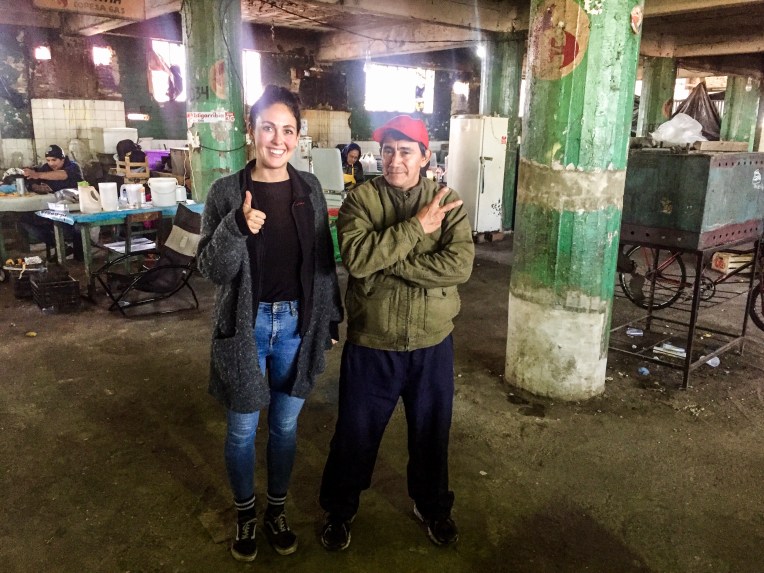
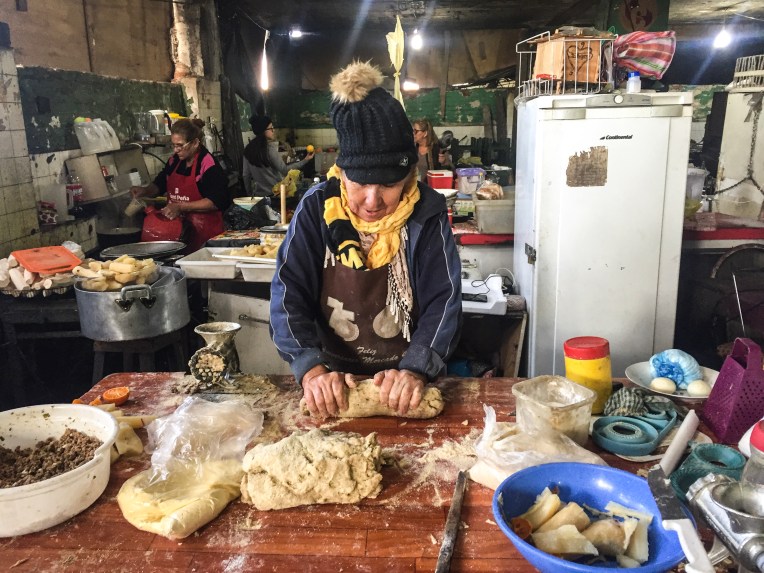
I met Markus, 50, father of 8 sons, in Asuncion, Paraguay right in the middle of Mercado Municipal 4, where he and his family serve food in a little corner hidden on the second floor of what seems to be a parking garage. Even though he only spoke Spanish and I don’t speak it well enough to have political discussions, we managed to get a short but very insightful interview. Thank you so much for your time and for letting us try your food.
How was growing up in Paraguay?
I grew up with my grandparents who both worked in the mines. When I was still quite young, my grandmother passed away and I had to move to my mother. During this time, I started working, selling and buying food on the streets. You see, when I was younger, during my early school days, the dictatorship of general Alfredo Stroessner (regime lasted from 1954 – 1989) only offered very bad education for us. There were schools, but they were all very rustic and simple and we did not have extra school supplies and not everybody was able to go. Support for poor families was missing. So, most kids had a choice – to go to a bad school or to work. Doing both was a rare concept in Paraguay. To work as a young person with bad education, it was typical to sell stuff on the street, as it still is today. Back then, you were not allowed to voice your opinion about politics due to the dictatorship, you had to keep your head down, otherwise they would have come and beat you or through you in prison. Another problem back then but still even today was that the government barely made any investments in our health system. If you compare our system with Brasil for example, there is barely any investment. Here, for example it is around 7 to 8 dollar per person in a year and in Brasil and Argentina it is 30 – 40 dollars per year. So, this is how we grew up. Bad education, bad health system and a dictatorship. Today, I am 50 years old, I have 8 sons. I started studying law, it was very very hard and it was too expensive, so I had to start working here.
What do you think are struggles und opportunities in Paraguay today and for the future of the country?
If you ask me, a country that cannot offer proper healthcare systems and education does not have any future (laughing). Everybody has to see how to take their own future into their hands within the bounds of the possible. Paraguay is a land of friendship, of friendly networks, which influence your future. It is not enough here if you have a professional education, but you need to know the right people at the right time and place to get further in life. But as nice as networking and connections sound, it is also a corrupt and unfair system. For example if a girl applies for a job, and the boss thinks she is very attractive, then we girl will get the job because of that. Not because of what she knows. Nowadays, we have governmental support and scholarships for education, but 80% of them go to the friends and family of the authorities and only the rest goes to us people. It is a very uneven distribution of support. Drug traffic was and still is also a big problem, especially at the borders to Brasil and Argentina and it is not a very good conversation to have in public, because of course, the government is involved as well. Very tricky subject. Cocaine, weed… it is disgusting to which extent these things are distributed among Paraguay. Corruption is, as in many South American countries still a problem. If your visa is expired you just need to pay somebody and they will extend it. If they catch you with a backpack full of cocaine, they will tell you that you will be thrown in jail, but you can buy your way out. It is a very vulnerable country.
But of course, problems are always more obvious than things that are actually positive here. For example our safety has improved extremely over the past 8 years, thanks to the government that has ruled recently. Education has become a little better as well, as I mentioned even though its unevenly distributed, there are more scholarships and social security for unemployed people. They now get 150$, so this is definitely an improvement.
What are typical values and traditions of your country?
Our values here in Paraguay are mainly family first, our children are everything to us and then work and personal development. One of our traditional dances is the Malambo and La Danza Paraguaya. We love to dance here and to celebrate. The languages we speak here are Guarani, Spanish and basic English.
What are typical local dishes of the country?
There are many local dishes that are very good. For example Chipa, it’s a roll made out of mandioca or yuca with cheese and for example eggs. We also love pastels and one dish, which I really like is Mbeju, which looks like a pancake and is also made out of yuca and pan-fried with cheese (actually a lot of things in Paraguay are pan-fried). And of course we have Terere – it is like mate in Argentina just with cold water, which is poured over the yerba. And we also have Asado and Empanadas, which we enjoy.
Describe Paraguay in 3 words
I would say amable ( friendly), because regardless of how our lives are, we always like to talk to people and love to make connections. Then, I would say we are muy compasido (very compassionate) and finally very helpful with each other.
Thank you, Markus!
 rannaway - diary of a traveler