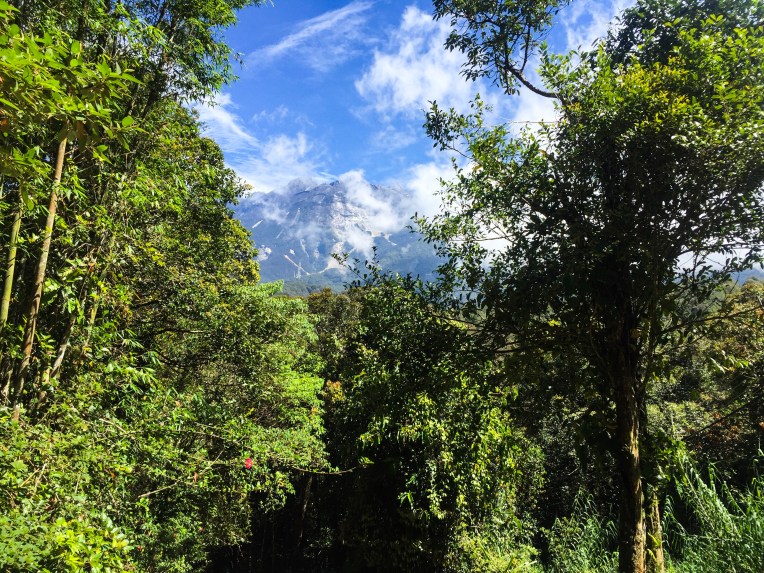
Fortunately, I was able to interview two wonderful individuals in Borneo, the second one being Uncle Jack, 61 years old and owner of Jungle Jack Backpackers, a container hostel right outside of Kinabalu National Park. Jack has a very special or rather tragic story to tell, as he was held responsible for the big earthquake in 2015. Responsible for an earthquake, you might ask? He told me the story and about his life in Sabah. Thank you, Jack, it was a very entertaining car ride with you.
Jack, how did you grow up?
I was brought up very happily, all my sisters and brothers spoiled me, because I was the youngest. My older brothers and sisters are 12-14 years older. They never hit me, but I still pretended to cry sometimes and pretended they hit me – I was very naughty as a kid. I grew up in a very educated family, both of my parents were politicians and very active in schools. My parents were already 49 and 61 when I was born. I was sent to school to Australia when I was 14 years old. Chinese and Indian usually send their children overseas for a better education, because we have more money. I was a lot of trouble when I was 12 to 14 years old, especially with the girls. In Australia, my aunt had a lot of trouble with me. When I got older, I eventually studied hotel management in Australia but more on the chef side in the kitchen, and it only took 2,5 years. After that, I stayed in surfers paradise for a while and in Hong Kong, but eventually I returned to Malaysia after some personal problems. In 1957, Borneo was still run by the British colony. After 1963, Sabah then joined Malaysian independence. So there was a different environment growing up. The reason why Sabah did not join the independence right away was because we grew a lot of timber, a lot of Tobacco and imported a lot of Tobacco to England. So it made more sense to stay as a colony a bit longer.
How did the change to Malaysia’s independence influence you and your family?
I was too young back then, I don’t know, but I noticed that suddenly the economy was not that good and whole Malaysia was struggling, and then just slowly it got better after a while. The prices got up, people did not have enough jobs and stuff like that. And the government changed, slowly all the British people disappeared and more Malay, Chinese and Indian moved into offices.
When did you first get into hospitality?
In 1988, I started my first bed and breakfast in KK, jacks BnB and I had 54 beds in total. The first two years were ok and after the third year, I was listed in Lonely Planet and every day I had a full house. I smuggled a lot of beer, because all of the Germans guests drank a lot of beer and all the backpackers stayed with me, because tourism was just starting in his area. It’s funny, because backpackers are the worst haha. They try to bargain with you about the price of accommodation, but never about the price of the beer. There they like to spend their money.
After my first hostel, I organized tours to the islands in KK, I am a dive master and I teach people how to dive. Just one advice, if you decide to dive, don’t drink before you go down. That is why my ear is now not very good, because of that.
Tell me a bit about Jungle Jack and how it developed?
8 years ago, I started to semi-retire, so I came up to Kinabalu mountain and started to build the first Jungle Jack with containers. People thought I was crazy, because I took the shipping containers. Thank god, I had a lot of volunteers, so the contains went from a shitty container to a nice, painted container. As long as you have good beds and blankets it’s fine to sleep in the containers, it’s colder here, but it’s all about ventilation. So, after that I had backpackers who said they wanted to climb the mountain and I started helping them in a cheaper way. I charged them a small amount of money and brought them up there. And then, once word spread that I was doing this, too many people wanted to do too many climbs a day, so we had to stop it for a while and they had to increase the prices a little bit. After the earthquake in 2015, they increased the price to climb of 220%. There are only a small amount of people allowed on the mountain now, before it was different. Nowadays it’s 1380 Rn to climb up there. My hostel also changed – Jungle Jack now can host 26 people. Before the earthquake I had a different location where 52 people were able to sleep, but I was asked to give this place up, because people in the village blame me for what happened.
What exactly happened in 2015 with the earthquake?
A few days before the earthquake, I guided one of my groups with around 27 people up the mountain. A few of the guys and girls decided to take a picture on top of the mountain, standing completely naked and somebody posted it on Facebook, even though I told them not to. The mountain is a holy mountain for the people in the village here and they are very superstitious, so it was obvious that this could be a big problem. After 5 days, there was an earthquake and 18 people died including one of my guests, it was terrible. Because people had seen the picture on Facebook, people started blaming Jungle Jack and the responsible backpackers that this tragedy happened, because they stripped naked and therefore disrespected the holy mountain. Of course, it was nobody’s fault but some of the guys were charged with money fines and arrested at the airport. We told them to leave as fast as possible, but they wanted to wait for a cheaper flight… it was in the news and everything and apparently a newspaper in the UK paid the charges for some of them. The consequence for us was that Jungle jack had to change locations – before we had a full on mountain view and now not any longer, because village people can get very violent, when they persist it is your fault and they did not want us to enjoy the mountain like that any longer. But honestly, they can’t get rid of me, so that’s why I have Jungle Jack two now, closer to the park entrance, so it works. But yeah, that is why our number one rule at Jungle Jack is now to keep your clothes on while climbing at all times. We want to keep people safe and give them the opportunity to enjoy the mountain.
What are the biggest struggles and opportunities of Sabah nowadays?
We need better education for next generations, they need to improve that. I think for Malaysia, Sabah is one of the main tourist attraction, especially in this area with Mount Kinabalu. And tourism will generate a lot of money. But the problem is, that more than 38% of the population of Sabah are already depending on tourism, because there are not a lot of other businesses due to lack of education and that is not very good. If it gets over 40% like for example in Thailand, as soon as something happens with the tourism industry, the whole country will collapse. So, the best percentage for tourism or revenue is 32% depending on tourism. But we are already over that. We do not have a lot of revenue, just with tourism, palm oil or petrol industry. You can not compete with Australia or Africa or all of these countries. So it’s better if they will provide better schools, better education so that we can build better businesses.
Besides that, Th palm oil industry is also not very good, because they are cutting down all of the trees. It’s difficult because you want to give jobs to the people and palm oil means jobs. But it is not good for the environment. But Chinese also buy a lot of oil from Malaysia. All the business men are Chinese and Indians you see, so they don’t care, they want more money and they start to plant more palm oil, because the prices are going up amazingly. They also cut down all of the mango trees, durian trees and the monkeys have to go deeper in the jungle, because they crash the animals by cutting down the trees. So the monkeys go further on the Indonesian side, because the jungle is way bigger there.
And one big struggle for Malaysia is also that Chinese and Indian people should be allowed to join the government department, because now it is just Malay that are working there and that leads to a misrepresentation of all three cultures within the country. For example, I know one girl, she is Chinese and she wanted to work for the government department and the government did not want to hire her based on her cultural background. She then went to the United States and she became a very successful scientist over there and now even China really wants her. And she does not want to come back to Malaysia, because they rejected her and she felt misrepresented.
Besides governmental disagreements, how is living side by side with different cultural groups in the country?
As long as we are happy, we don’t want to create any trouble for each other. Like me, I am happy at Mount Kinabalu. So, I don’t want to go to the politicians and say for example, Malay get out of here, that is not my right and I don’t want that either. But the other way around, Malaysians tend to says to Chinese and Indians, if you don’t like how it is here, go back to your country. But where is our country? Our country is Malaysia, we have been staying here for hundreds of years.
Besides Mount Kinabalu, what are your favorite places in Sabah?
The first favorite place is here, obviously, Mount Kinabalu, the second favorite place is Sipadan and then the third for me is anywhere where you can try the food from here. The food in Sabah is amazing. Mount Kinabalu is the highest mountain in Southeast Asia, so many foreign people want to climb that Malaysians can’t even climb it any longer. And the climbs are very well organized, but there are not so many permits any longer. And Sipadan is just beautiful. It is a famous diving spot, but it is not cheap. And the permits are not easy to get.
So, what is your favorite food here in Sabah?
Traditional food, for example a kind of soup with rice noodles, it’s a beef stew, that is very popular. Especially Chinese and Malay know how to do it. And the Indian food also, I love their food and Chinese of course is good as well. BBQ pork is very good, it’s very nice together with rice.
Describe Sabah in three words
This is difficult for me, because I was born here, I love this country. I am a sea man, I took people diving. I love the mountain. I like the weather, I met so many people over the past years. So, for three words- it is hard to decide. I think one word that I can give you is nature. Because you see more nature here than anywhere else.
Thank you, Jack!
 rannaway - diary of a traveler
One thought on “The Local’s Perspective, Mount Kinabalu Edition”